
A brand needing the same 60-second product explainer in English, Arabic, and Hindi once faced two practical options: reshoot the video with different presenters or use subtitles over one original version.
AI video generation creates a third option. One approved script and presenter can be adapted into several languages with matched voice delivery and lip movement, reducing the time and cost required for separate productions.
The practical shift: AI video is most valuable when brands need multiple versions, languages, formats, hooks, or short-form edits from the same core idea.
How AI video generation works
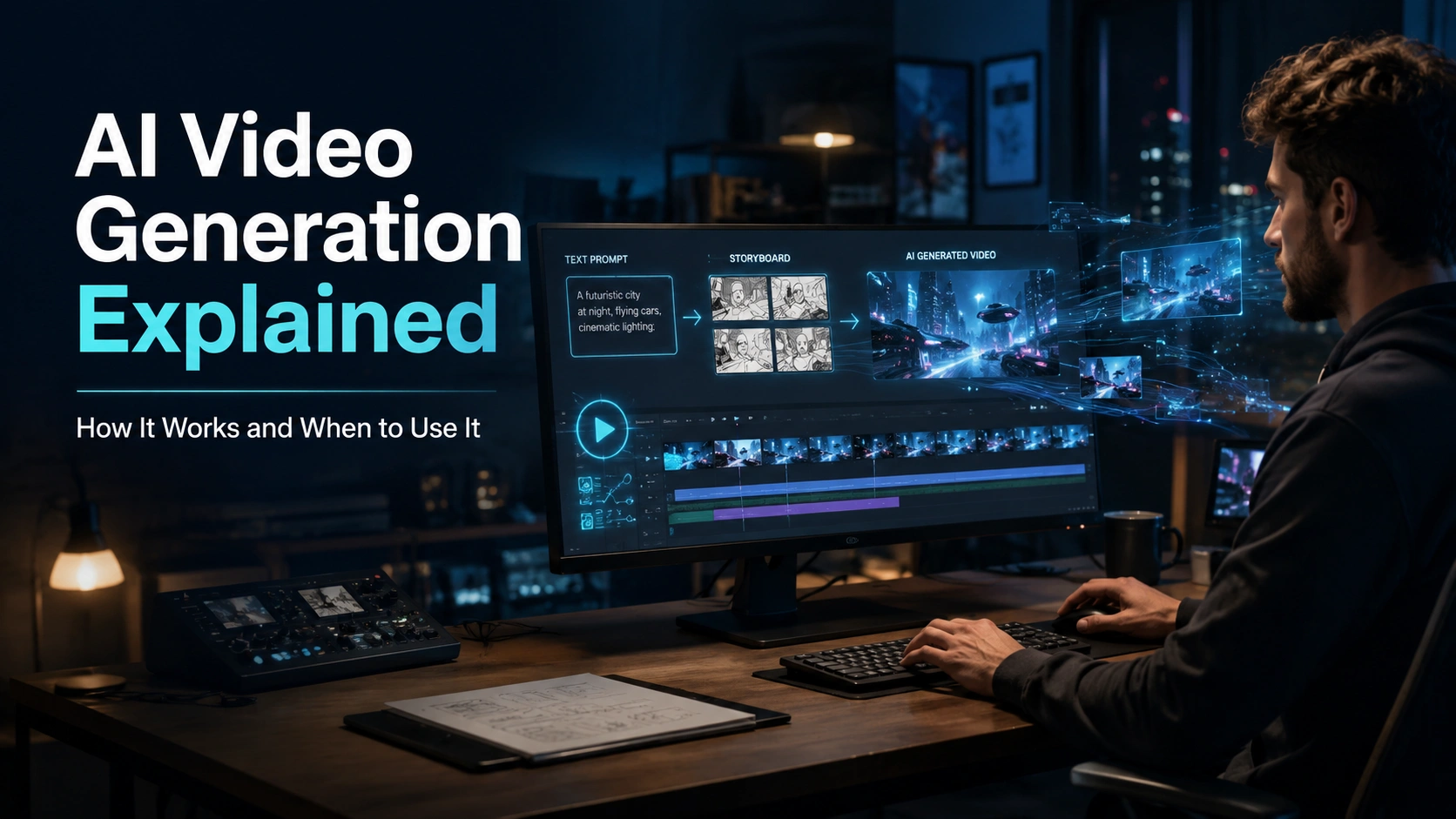
Modern AI video tools are trained on large collections of images and videos. These systems learn visual patterns, movement, lighting, framing, speech, and scene relationships, allowing them to generate or modify video based on written instructions and reference material.
Text-to-video
A written prompt describes the scene, subject, camera movement, lighting, style, and action the system should generate.
Image-to-video
A still product image, design, character, or photograph is animated with controlled movement and camera motion.
AI presenters
A digital presenter delivers an approved script without requiring a physical studio, camera crew, or reshoot.
A separate group of AI tools focuses on editing rather than complete generation. These platforms can identify highlights, create short clips, remove pauses, generate captions, reframe horizontal footage vertically, and match music to scene pacing.
Where the numbers favour AI video
| Use case | Traditional production | AI video |
|---|---|---|
| 60-second product explainer | Approximately ₹40,000–₹1,50,000 or more, with one to three weeks of production time | Can often be completed at a lower cost within several days, depending on complexity and revisions |
| One video in three languages | May require separate presenters, voice recording, dubbing, editing, or near-complete reshoots | One approved version can be adapted into multiple languages with matched delivery |
| One webinar converted into ten clips | Requires manual reviewing, cutting, captioning, reframing, and exporting | Highlight detection, short-form editing, captioning, and reframing can be largely automated |
| Five advertising hook variations | May require several scripts, recordings, edits, or reshoots | Several variations can be produced rapidly for controlled testing |
Where traditional video production still wins
AI-generated video is not the strongest option when authenticity is the central value of the content. Genuine customer testimonials, founder stories, documentary-style films, event coverage, interviews, and brand films built around real people and locations still benefit from traditional production.
Real emotional performance
Personal stories, unscripted reactions, subtle expressions, and emotional conversations remain more convincing when captured from real people.
Recognisable people and places
Audiences may already trust a founder, employee, customer, facility, store, or location that should be shown accurately.
Complex product interaction
Products requiring detailed demonstrations, physical handling, technical accuracy, or regulated claims may need controlled filming.
Flagship brand storytelling
High-value campaigns designed to define the brand may justify original direction, cinematography, sound, casting, and production design.
The hybrid approach working for brands
The strongest strategy is usually not complete replacement. AI handles high-volume content that needs to be produced quickly, while traditional production is reserved for work where real people, real environments, and emotional authenticity carry greater value.
- Use traditional production for hero campaigns, founder stories, testimonials, interviews, and important brand films
- Use AI video for multilingual adaptations, social clips, product explainers, internal training, and advertising variations
- Use AI editing tools to turn long recordings into short-form content across several platforms
- Use rapid AI variations to test hooks, opening scenes, messages, formats, and calls to action before investing in a larger campaign
A practical allocation: produce one flagship video with a full production team, then use AI tools to create localised versions, social edits, format adaptations, and campaign variations from the same strategy.
Frequently asked questions
Will AI video replace traditional video production?
Not entirely. AI is replacing or accelerating selected categories such as explainers, localisation, social editing, training content, and advertising tests. Brand films and authentic storytelling still benefit from traditional production.
Can AI-generated video look professional?
Yes. Professional results are increasingly possible for product visuals, talking-head presentations, explainers, short social clips, concept films, and stylised advertising. Quality still depends on source material, prompting, editing, consistency, and human review.
Is AI video cheaper than hiring a videographer?
It is often more cost-effective for high-volume variations, localisation, simple explainers, short-form edits, and testing. Traditional production provides greater value when the project depends on real performance, unique locations, detailed direction, or authentic storytelling.
Monk Media One combines AI video workflows with traditional production, selecting the method that best suits the content objective, required authenticity, budget, production timeline, and number of deliverables.
Choose the right production method for every video.
Compare AI generation, traditional production, and hybrid execution for your next campaign.