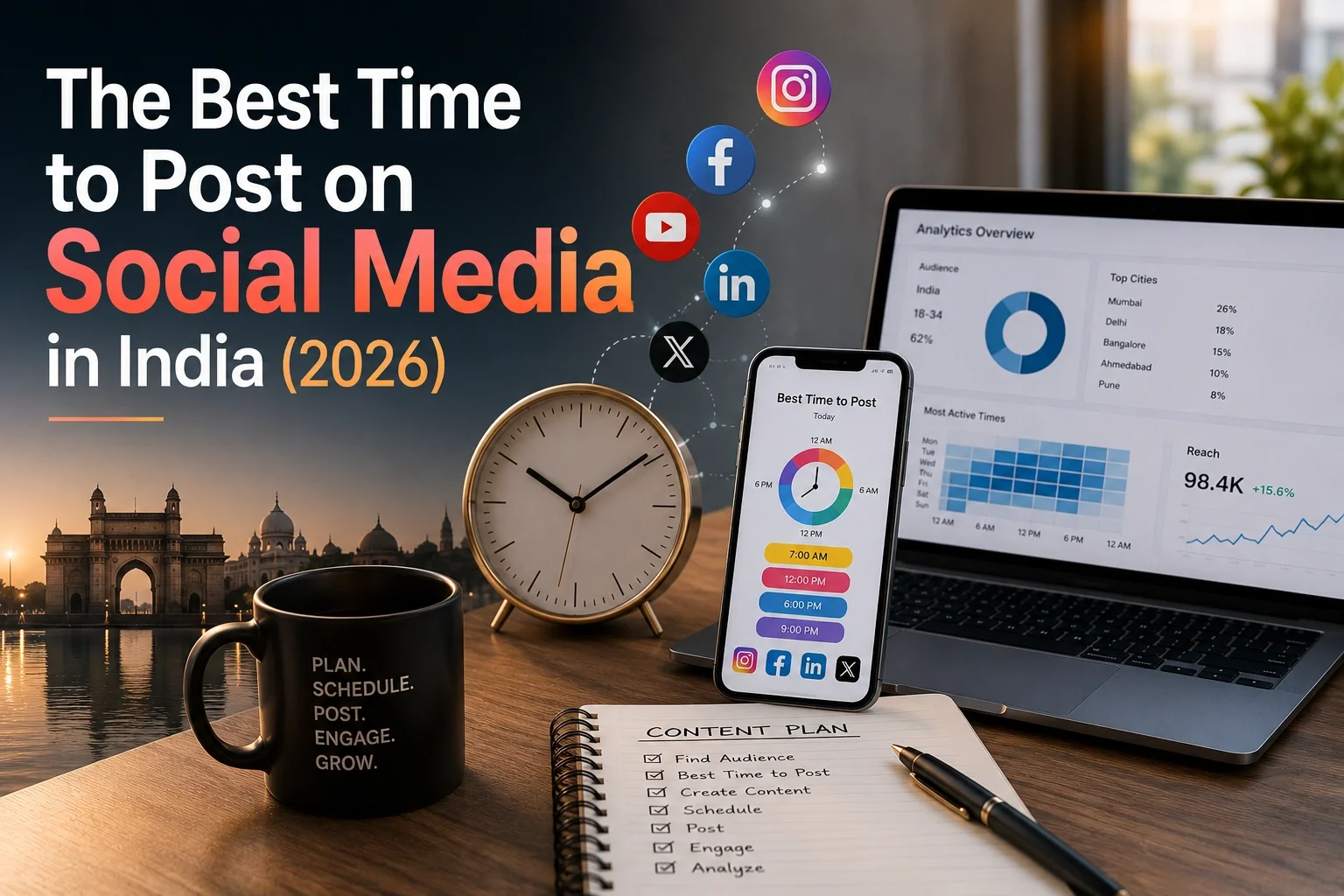
Posting at the right time affects how many people see your content — but timing is the third thing to optimise, not the first. If your content is weak, posting at 8pm won't save it. That said, for content that's already good, posting at the right time in India can meaningfully improve reach.
The honest caveat: These are starting points derived from aggregate data. Your audience in Ahmedabad or Gujarat may behave differently from national averages. Use these as your initial posting schedule, then adjust based on your own analytics after 30 days.
Best posting windows (IST) by platform
Instagram
Early morning (7–9 am), lunch (1–2 pm), and evening (8–10 pm). Reels perform well throughout the day — prioritise consistent publishing over perfect timing.
Facebook
Weekday afternoons (1–4 pm) and evenings (7–9 pm). Facebook reaches slightly older demographics in Gujarat — adjust for your audience.
LinkedIn
Tuesday, Wednesday and Thursday: 9 am–12 pm. B2B decision-makers are most active on weekday mornings. Avoid weekends.
YouTube
Saturday and Sunday afternoons for longer content. Weekday evenings (6–9 pm) for Shorts. Indians watch YouTube in leisure time.
How to find your actual best time
- Post at the general best times above for 30 days consistently
- Check your platform's Insights/Analytics for "When your audience is online"
- Identify your top 5 performing posts and note when they were published
- Adjust your schedule toward those windows and test for another 30 days
The factor that matters more than timing
Instagram's and Facebook's algorithms both reward engagement rate — the percentage of people who see your post and interact. A post with high engagement in the first hour gets pushed to more people regardless of when it was published. Consistency of posting, quality of content, and prompt engagement with comments will always outperform perfect timing on mediocre content.
A data-driven content calendar for your brand.
Our social media team builds and manages content schedules for Gujarat businesses.
Why published "best times" are close to useless
Every list of optimal posting times is an average across thousands of accounts in different categories,
countries and audience types. Your audience is not that average, and the gap is not small.
A B2B manufacturer in Gujarat whose buyers check their phones between meetings has nothing in common
with a dessert brand whose customers scroll after dinner. Applying the same "best time" to both is
guaranteed to be wrong for at least one, and probably both.
There is also a structural reason the question matters less than it used to: Instagram, Facebook,
LinkedIn and YouTube all serve content by predicted interest rather than strictly by recency. Posting
time influences the first hour of distribution, and the first hour influences what happens next — but
a good post published at a mediocre time will outperform a weak post published at the perfect one.
Find your own times in twenty minutes
- Instagram: Professional dashboard → Total followers → Most active times. It gives you
days and hours for your actual audience.
- Facebook: Page insights shows when your followers are online.
- LinkedIn: Page analytics shows visitor and follower activity by day.
- YouTube: Analytics → Audience → When your viewers are on YouTube.
Post an hour or so before the peak so the content is in the feed as attention arrives. Then test around
it: hold everything else constant for a few weeks, vary the time, and compare reach on similar content.
What matters more than timing
- The first three seconds. On video, the hook decides everything downstream. No posting
time rescues an opening nobody watches past.
- Consistency. A predictable rhythm the audience learns beats sporadic bursts at
theoretically optimal moments.
- Replying quickly. Early engagement signals matter, and comments answered in the first
hour generate more of them.
- Format fit. Vertical video for Reels and Shorts, carousels for teaching, native text
for LinkedIn. The right format at the wrong time beats the wrong format at the right one.
The Indian calendar, which does matter
Timing at the day and season level is genuinely worth planning, in a way that hour-of-day is not.
Festival periods change both attention and buying intent sharply — Navratri and Diwali in Gujarat
particularly, and the wedding season after them. Attention rises, and so does competition for it and
the cost of paid reach.
Plan festival content weeks ahead rather than days, because production time and approval cycles are what
actually determine whether you post at the right moment. The brands that appear effortless during
Navratri finished the assets in August.
Frequently asked questions
What is the best time to post on Instagram in India?
The only answer worth acting on comes from your own account: Professional dashboard → Total followers → Most active times shows the days and hours your actual audience is online. Published national averages describe a blend of audiences that does not include yours, and the difference between categories is large enough to make them misleading.
Does posting time still matter with algorithmic feeds?
Less than it used to, but not zero. Feeds rank by predicted interest rather than recency, so a strong post finds its audience whenever it goes out. Timing still shapes the first hour of distribution, and early engagement feeds the ranking — so it is worth getting roughly right and not worth agonising over.
How often should we post?
At a rhythm you can sustain indefinitely. Three good posts a week maintained for a year will beat daily posting abandoned after six weeks, both in audience trust and in what the platform learns about your account. Pick the cadence your production capacity actually supports.
Should we post differently during Navratri and Diwali?
Yes — attention and buying intent both rise sharply, and so does competition for reach. The practical implication is a production one: festival content needs planning weeks ahead, because approval cycles and shoot schedules, not creative ideas, are what usually cause brands to miss the window.
Is it worth using a scheduling tool?
For consistency, yes. Scheduling removes the main reason posting slips, which is that someone was busy on the day. Keep replies and comments live and human, though — scheduling the publishing is helpful, automating the conversation is not.