
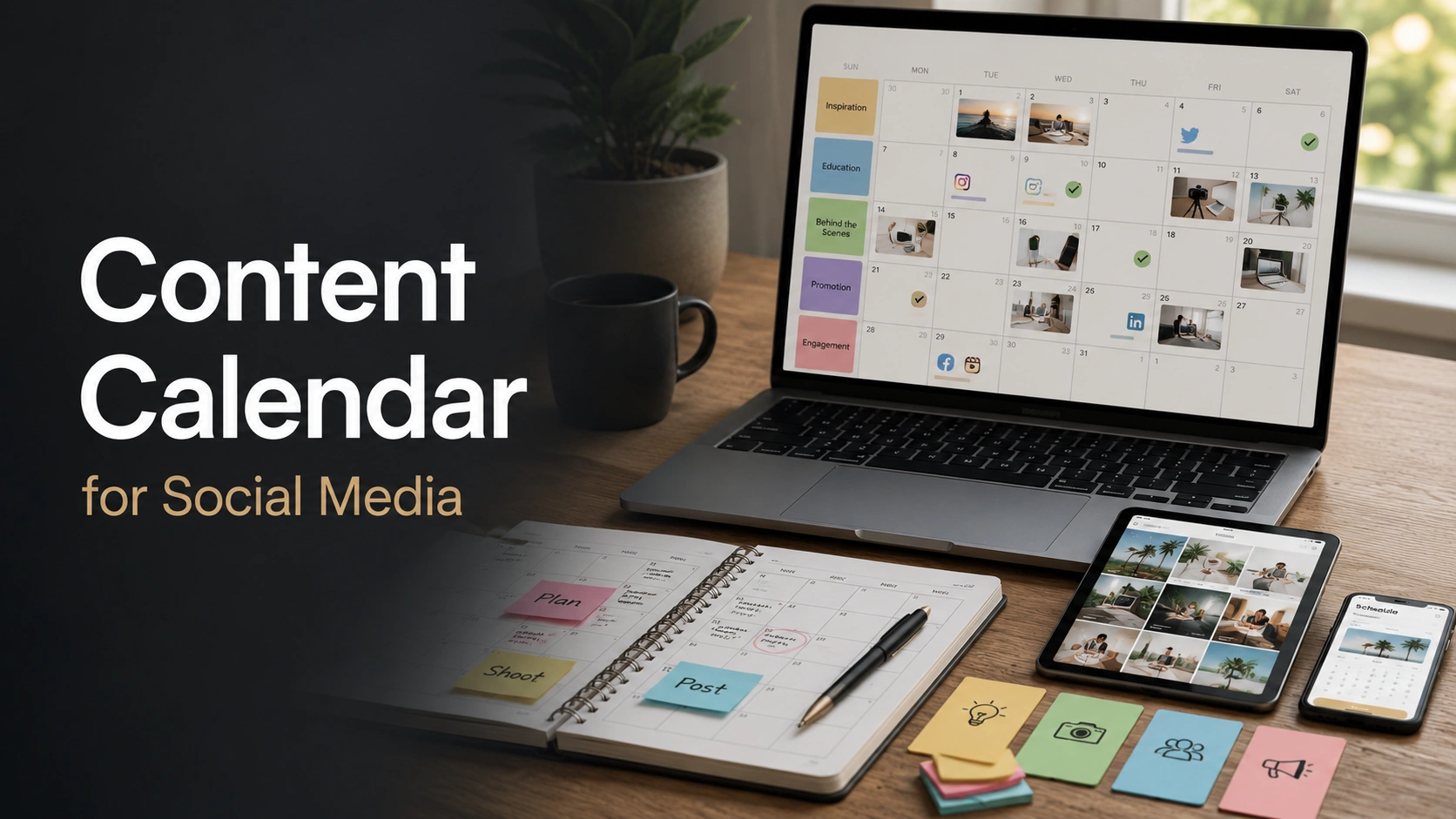
Many inconsistent business accounts follow the same pattern: several weeks of enthusiastic daily posting, then silence, followed by a rushed attempt to restart.
The problem usually is not a shortage of ideas. It is that content decisions are being made reactively every morning instead of through a repeatable system.
A content calendar moves the decision-making upstream so your team can focus on producing better content instead of deciding what to post every day.
Step 1: Choose a cadence you can maintain
Three strong posts every week for twelve weeks will usually create more consistent output than seven rushed daily posts that stop after one month.
Choose a publishing frequency your team can realistically maintain for a full quarter.
Step 2: Define 3–5 content pillars
| Content pillar | Examples |
|---|---|
| Educational | How-to tips, common mistakes and answers to real customer questions |
| Social proof | Testimonials, case studies and before-and-after results |
| Behind the scenes | Your team, process and how products or services are actually delivered |
| Product / service | Features, benefits, use cases and demonstrations |
| Industry commentary | Trends, opinions and timely reactions |
Content pillars eliminate the blank-page problem because every idea has a clear category to belong to.
Step 3: Use a balanced content ratio
A practical starting point is approximately 70% value or education, 20% engagement and community content, and 10% direct promotion.
Accounts dominated by sales messages often lose engagement because followers begin treating every post like an advertisement.
Step 4: Plan ahead and batch production
Plan the next month loosely and finalise the coming week in detail.
Whenever possible, produce similar content together. Record several videos in one session, design multiple posts together and prepare captions in batches.
Batch production reduces setup time and makes quality easier to maintain consistently.
Step 5: Reserve space for real-time content
Keep roughly 10–20% of the calendar open for timely opportunities such as trends, industry developments, events and spontaneous behind-the-scenes moments.
A calendar should create structure without making the brand feel completely pre-programmed.
Step 6: Let performance change the plan
Review which pillars, formats and topics actually perform with your audience each month.
Useful metrics include reach, saves, shares, comments, watch time, profile visits, website clicks and enquiries.
If one content pillar repeatedly performs better, increase it. If another consistently underperforms, revise or replace it.
A practical content-calendar structure
Publishing date
Define when the post is scheduled to go live.
Platform and format
Specify whether the asset is a Reel, carousel, static post, Short or another format.
Content pillar and topic
Connect every post to one strategic content category.
Hook, caption and CTA
Plan the message and intended user action before production.
Production and approval status
Make it easy for everyone to see what is planned, produced, approved and published.
Frequently asked questions
What tools work best for a content calendar?
A shared spreadsheet works well for small teams. Dedicated scheduling platforms become more useful when managing several channels, brands or approval stages.
How far in advance should I plan?
One month of loose planning with the next week fully finalised usually provides a good balance between structure and flexibility.
What if I run out of ideas?
Return to your content pillars and the questions customers ask most frequently. Those questions are often the strongest source of useful content.
Monk Media One builds content calendars around clear pillars, sustainable publishing schedules and formats designed for each platform.
Build a content system your team can actually maintain.
Replace reactive daily posting with a clear, repeatable content calendar.
Explore Content Strategy