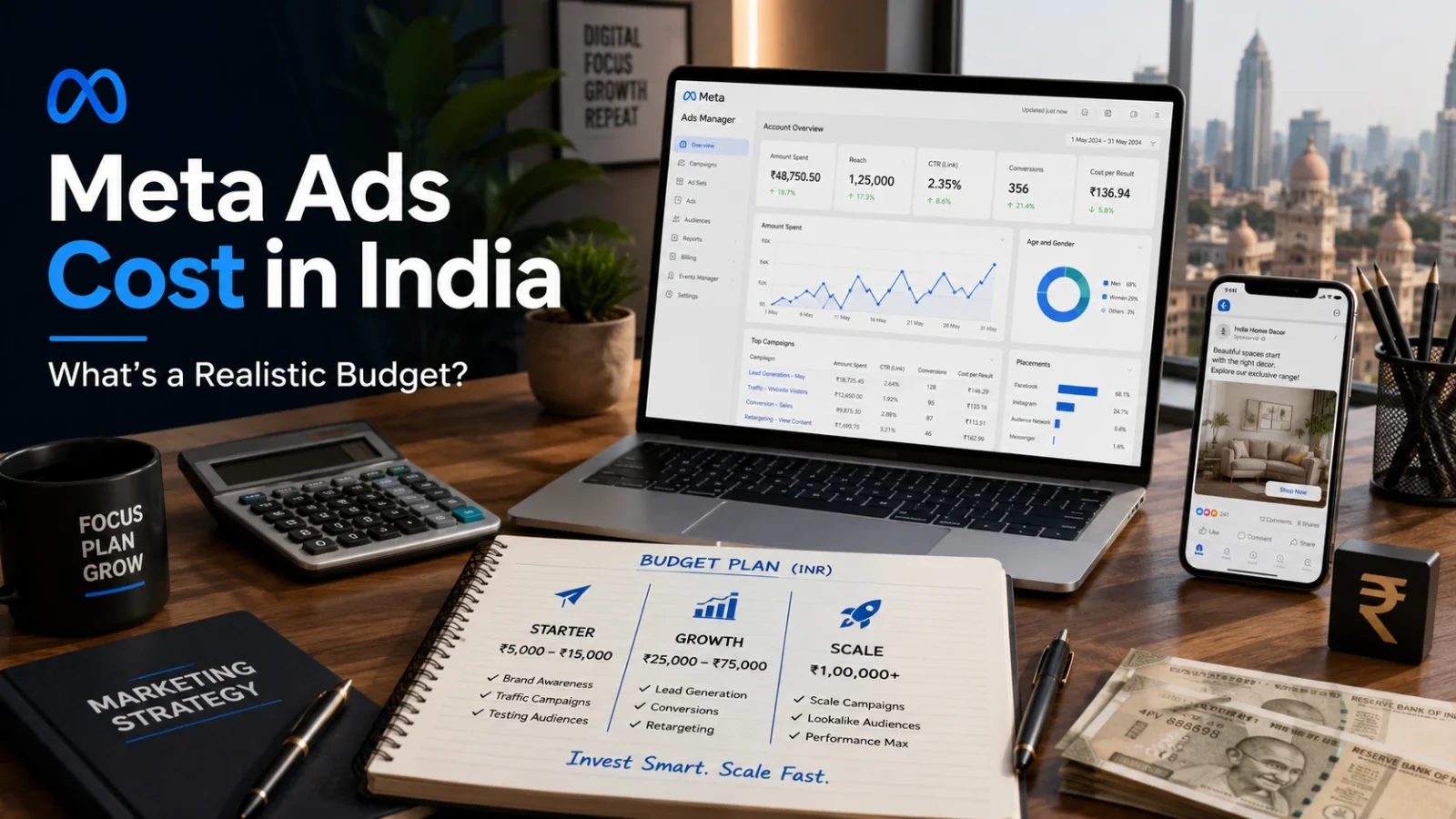
A business runs Meta Ads at ₹300 per day for two weeks, gets a handful of inconsistent leads and concludes that the platform does not work.
What may actually have happened is that the campaign was stopped before Meta collected enough conversion data to optimise delivery properly.
A campaign needs enough budget and conversion volume to learn before its performance can be judged fairly.
Realistic Meta Ads benchmarks in India
| Metric |
Typical range |
| Cost per click |
₹5–₹25 |
| Consumer / e-commerce lead |
Often ₹50–₹200 |
| Real estate, finance or B2B lead |
Often ₹200–₹500+ |
| Practical daily testing spend |
Approximately ₹500–₹1,000 per day |
| Realistic monthly SME test budget |
₹15,000–₹50,000 |
These numbers should be treated as benchmarks rather than guarantees. The actual result depends on the industry, audience, geography, offer, creative quality and customer value.
Why the minimum budget matters
Meta's advertising system learns from conversion events.
The more useful conversion data it receives, the better it can understand which users are likely to respond and where the budget should be allocated.
When a campaign generates too little data, delivery remains broad and results can stay expensive and unstable.
This does not automatically mean the product or targeting is wrong. The campaign may simply not have collected enough information yet.
Your campaign objective changes what Meta optimises for
An awareness campaign can generate inexpensive reach, video views and impressions.
Those numbers may look attractive in a report, but awareness campaigns are not primarily optimised to generate purchases or qualified enquiries.
Lead-generation and purchase campaigns generally cost more per action because the platform is optimising toward a more valuable outcome.
A campaign can perform well against the wrong objective and still fail commercially.
The real budget is more than the media spend
Ad spend is only one component of the complete Meta Ads investment.
Businesses should also consider:
Creative production
Copywriting
Landing-page optimisation
Tracking setup
Campaign management
Testing and reporting
Strong targeting cannot fully compensate for weak creative or a poor conversion experience after the click.
Agency management fees commonly use either a fixed retainer or approximately 15–25% of advertising spend, depending on budget and scope.
A realistic first-campaign plan
For many SMEs, ₹15,000–₹50,000 is a more useful starting test range than a very small daily budget spread across multiple audiences and campaigns.
Allow approximately three to four weeks of reasonably stable delivery before making major conclusions.
Frequent changes to targeting, optimisation events, budgets and creative can disrupt learning and make results harder to interpret.
At the end of the testing period, evaluate:
Cost per qualified lead or purchase
Lead quality
Conversion rate
Creative performance
Landing-page performance
Actual business revenue
Frequently asked questions
Why did my cost per lead suddenly increase?
Common causes include creative fatigue, increasing competition, audience saturation, landing-page issues or changes in customer demand.
Should I manage Meta Ads myself?
Self-management can work at smaller budgets if someone has the time to learn the platform, configure tracking and produce fresh creative consistently.
How much should go toward agency fees?
Management commonly uses a fixed monthly retainer or approximately 15–25% of media spend depending on campaign complexity and total budget.
Monk Media One plans Meta Ads campaigns around realistic budgets, customer value, creative requirements and the amount of conversion data required to evaluate performance properly.
Build a Meta Ads budget around real campaign economics.
Start with enough data, strong creative and conversion tracking before deciding whether the platform works.
Explore Paid Marketing
Why "what do Meta ads cost" is the wrong question
Meta does not have a price. It has an auction, and what you pay per result is set by how much your
competitors are willing to pay for the same attention, how good your creative is, and how well your
landing page converts the click you bought. Two businesses in the same city and category routinely pay
three times different costs per lead, and the creative explains most of that gap.
The useful question is not the cost per click but the maximum you can afford to pay for a customer.
Work backwards from that: if a customer is worth ₹10,000 in gross profit and one in five enquiries
closes, you can pay up to ₹2,000 per enquiry before the campaign stops making sense. Every decision
after that is about getting under that number, not about getting a cheap click.
The budget floor nobody mentions
There is a minimum below which Meta campaigns do not work, and it has nothing to do with what you can
afford. The algorithm needs enough conversion events per week to leave the learning phase and optimise.
Below that threshold it never learns, so performance stays erratic and every result looks like luck.
The practical consequences:
- Concentrate, do not spread. One ad set with enough budget to gather data beats five ad
sets each starved of it. Splitting a small budget across audiences is the most common way a campaign
fails.
- Optimise for an event that actually happens. If purchases are rare, optimise for an
earlier event — an add-to-cart, a qualified form fill — so the system gets signal.
- Give it time before judging. The first ten days to two weeks are the campaign learning.
Changing budgets or creative mid-learning restarts it.
Where the money actually goes
A Meta budget has three components, and businesses new to it usually plan only the first:
- Media spend. What Meta charges. This is the only line most people budget for.
- Creative production. Testing needs volume — a campaign needs a dozen assets, not one.
Static images, short video and variations of each. If you have no budget for creative, your media spend
is buying repeated impressions of one idea that may not work.
- Management. Whether that is an agency fee or someone internal spending real hours.
Campaigns left alone degrade as audiences saturate.
A reasonable planning split for a first campaign is to treat creative and management together as a
meaningful fraction of the media budget rather than an afterthought.
The four things that lower cost per lead fastest
- Better creative. The single biggest lever, by a distance. A concept that stops the
scroll costs the same to serve as one that does not.
- A landing page that matches the ad. Sending traffic to a homepage is the second most
common failure. The page should answer exactly what the ad promised, immediately.
- Faster follow-up. Lead quality is often blamed when the real problem is that enquiries
are called back the next day. Response time changes conversion more than most targeting changes.
- Correct conversion tracking. If Meta cannot see which clicks became customers, it
optimises toward the wrong people. Server-side tracking is worth setting up properly once.
Frequently asked questions
What is a realistic starting budget for Meta ads in India?
Rather than a fixed figure, work from the arithmetic: your budget needs to buy enough conversion events each week for the algorithm to optimise, and it needs to run for at least two to four weeks before the results mean anything. If your maximum affordable cost per enquiry multiplied by a handful of weekly enquiries is more than you can spend, the campaign will not exit the learning phase and the money is better spent elsewhere.
Why did my cost per lead go up after a few weeks?
Usually audience saturation or creative fatigue — the same people have now seen the same ad several times, so response falls and the auction cost rises. The fix is new creative rather than a bigger budget. This is why campaigns need a pipeline of assets rather than one good ad.
Are the leads from Meta lower quality than from Google?
Often, and for a structural reason: Google captures people already searching for a solution, while Meta interrupts people who were not looking. That is not a flaw, it is a different job — Meta creates demand, search captures it. Judge Meta on cost per qualified enquiry after your own qualification, not on raw lead count.
Should we use lead forms or send people to a landing page?
Instant forms produce more leads at a lower cost and typically lower intent, because the friction is almost zero. Landing pages produce fewer, better-qualified enquiries. If your sales team has capacity to work volume, forms can win; if their time is expensive, a landing page usually nets out better.
Do we need to spend on creative as well as media?
Yes, and it is the line that most improves results. Testing requires a dozen assets rather than one, and creative fatigue means that pipeline never stops. A campaign with a large media budget and one ad is worse value than a smaller media budget with a proper set of concepts being tested.