
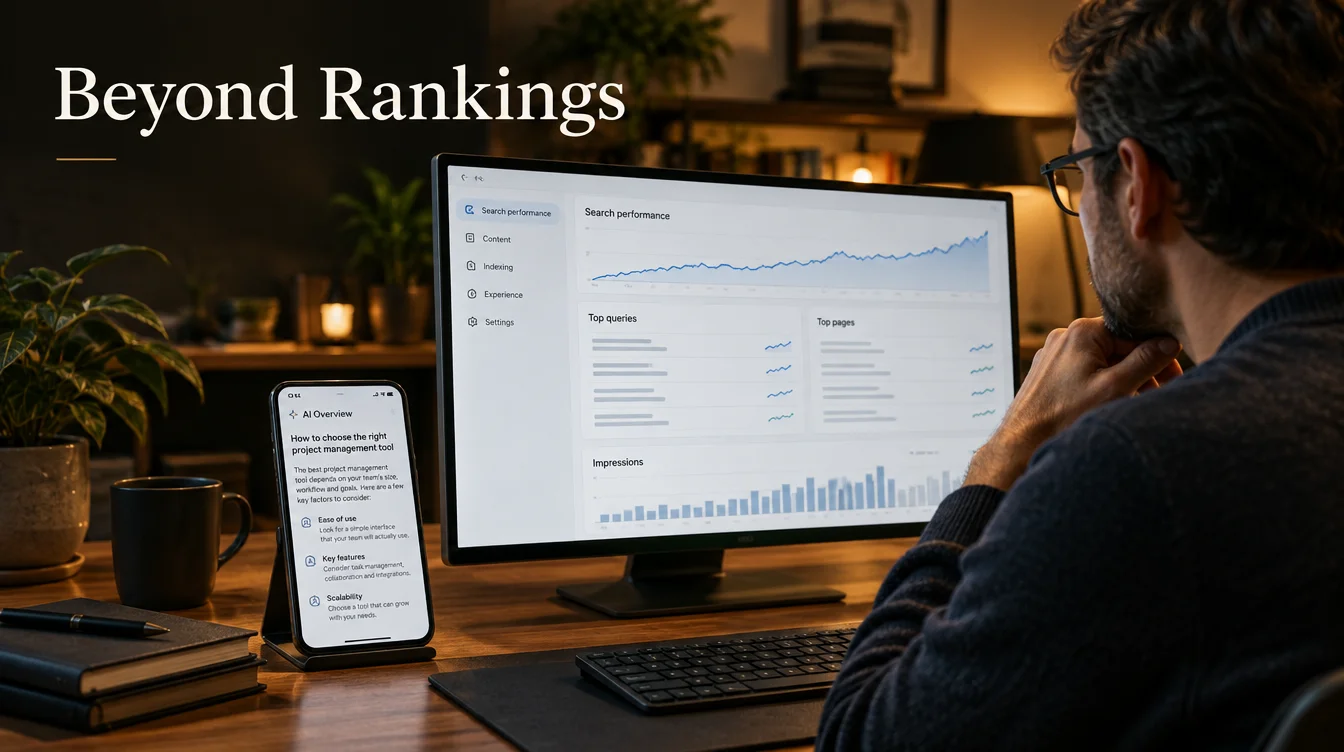
A monthly SEO report arrives in a founder's inbox. Twenty keywords have improved, the traffic graph is green, and the agency has highlighted three pages now ranking on page one. The founder asks a different question: When buyers ask an AI search tool who can solve our problem, does our business even appear?
That is no longer a theoretical question. In June 2026 Google announced dedicated reporting for visibility in generative AI features within Search Console. Google said those insights were available worldwide by the end of August; in September it also announced reporting for searches that start with images. These reports create new ways to examine discovery, but they do not turn AI citations into guaranteed leads.
A ranking report and a discovery report answer different questions
Traditional SEO reporting can show queries, clicks, position and landing-page performance. A business also needs to understand whether its useful pages are surfacing in AI-generated answers, whether visual searches expose its products or services, and whether visitors who do arrive do something commercially meaningful.
A manufacturer selling industrial control panels, for example, may rank for a broad category term. But a buyer might ask a detailed question about integration requirements, commissioning timelines or operating conditions. A generic service page offers little to a search system—or the buyer—trying to answer that specific question.
The useful test: could a buyer quote your page in a meeting?
Open your five most commercially important pages. Remove the logo and company name. Would a procurement manager still find credible answers to the questions they actually ask? A useful page might explain what is included in commissioning, what inputs are needed for a quote, which installations are appropriate, and where projects commonly fail. A page promising only “innovation, excellence and end-to-end solutions” contributes very little.
Google's published guidance for AI search continues to stress original, people-first content and conventional SEO foundations. There is no magic AEO tag that makes an AI answer recommend your brand. That is an important correction to agencies selling guaranteed AI visibility.
What to ask at your next SEO review
Ask for three views side by side: (1) search and generative-AI visibility where the report is available; (2) the pages attracting relevant visits; and (3) qualified enquiries connected to those visits. Then ask which page gaps were closed during the month—not how many articles were uploaded.
A service business can start with one honest page that explains a costly customer decision. Add original examples, transparent limitations, real process details, author or company credentials, and relevant imagery. Keep it crawlable, readable and fast. Monitor changes without promising an overnight ranking win.
The decision to make now
Do not cancel SEO because AI answers exist. Do not buy an expensive “AI ranking package” because someone says SEO is dead. Change the review question from How many keywords moved? to Can buyers discover and verify us where they are asking questions, and does that lead anywhere useful?
That is a more demanding report. It is also closer to what a business owner is actually paying for.
Work on the problem that actually matters.
Explore a practical next step with Monk Media One—based on your business context, not a one-size-fits-all package.
Review Your Search Strategy