
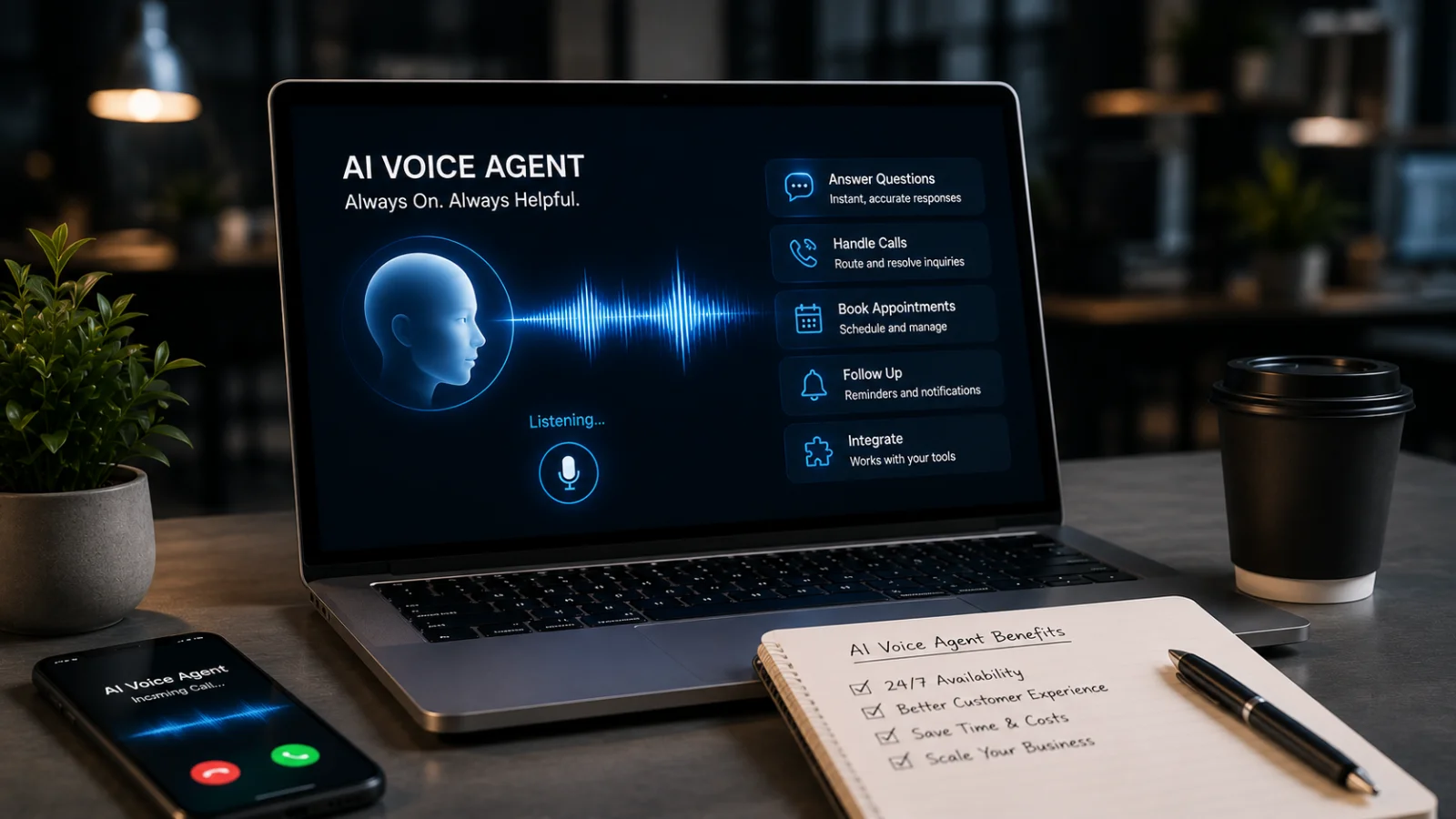
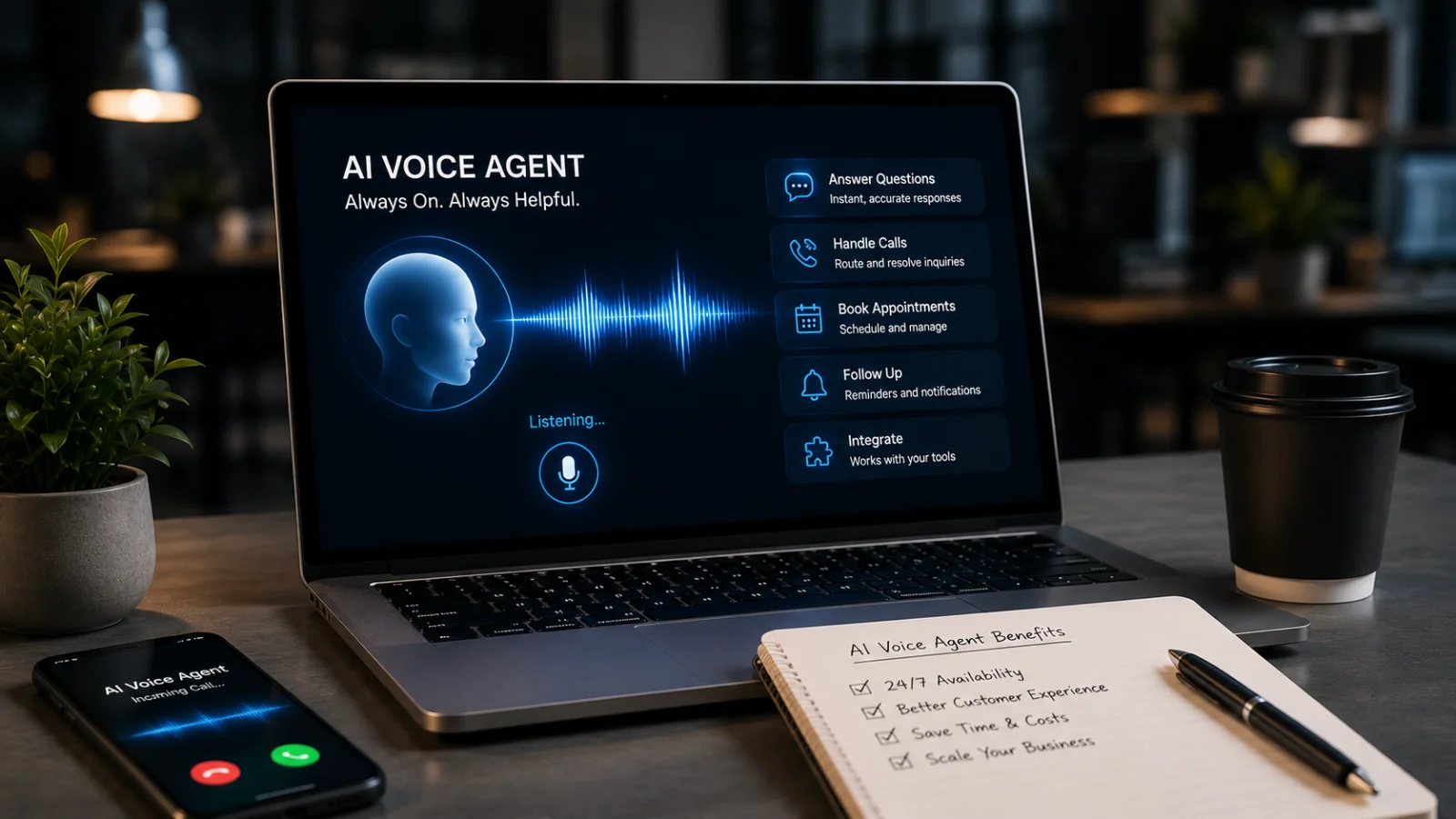
A missed business call is often more expensive than it appears. When a potential customer reaches voicemail, many simply contact the next business that answers.
AI voice agents are designed to reduce that gap by answering routine calls, understanding natural speech and completing predefined tasks automatically.
An AI voice agent is not simply an automated phone menu. It can understand intent, respond conversationally and trigger actions in connected business systems.
What an AI voice agent can do
| Use case | What the agent handles | Business benefit |
|---|---|---|
| After-hours calls | Answers when the team is unavailable and captures the enquiry | Reduces missed opportunities |
| Appointment booking | Checks availability and books or reschedules appointments | Reduces repetitive administrative calls |
| Lead qualification | Asks predefined questions before routing the opportunity | Helps sales teams prioritise better leads |
| Frequently asked questions | Handles hours, location, availability, basic pricing and policies | Reduces repetitive support workload |
| Overflow support | Handles simple calls when human staff are busy | Improves response speed during peak periods |
How it differs from traditional IVR
Traditional IVR systems depend on fixed menus such as “Press 1 for sales” and “Press 2 for support.”
AI voice agents allow callers to speak naturally.
A customer can say, “I need to move tomorrow's appointment to Friday,” and the system can identify the intent, ask any required follow-up questions and trigger the correct workflow.
Where a human should take over
AI should not attempt to handle every situation.
A reliable implementation needs clear escalation rules for complaints, complex negotiations, sensitive conversations, high-value opportunities and cases where the system has low confidence in its answer.
The quality of the human handoff matters just as much as the quality of the AI conversation.
Does an AI voice agent sound robotic?
Modern voice systems can sound significantly more natural than traditional automated phone systems.
However, quality still depends on the platform, language, pronunciation, latency, script and configuration.
Businesses should test the agent using real customer scenarios before launch rather than relying only on a demonstration.
Can AI voice agents support Indian languages?
Many platforms increasingly support Hindi and other regional languages, but performance can vary across accents, mixed-language conversations, names, addresses and industry terminology.
Testing with the actual target audience is therefore essential.
Will AI replace the receptionist?
In most businesses, the stronger use case is support rather than complete replacement.
AI can handle repetitive and predictable calls while the human team focuses on complex, emotional or commercially important conversations.
This is particularly useful for after-hours calls and peak periods when staff capacity is limited.
Frequently asked questions
Can an AI voice agent book appointments?
Yes, when connected to the business's calendar or booking platform through an appropriate integration.
Can it transfer a caller to a human?
Yes. Escalation rules can route specific conversations to a person when required.
Which businesses benefit most?
Clinics, salons, hospitality businesses, service companies and teams receiving high volumes of repeatable enquiries are often strong candidates.
Monk Media One builds AI voice workflows connected to CRM and booking systems, with qualification logic and clear human handoff rules.
Turn more incoming calls into structured customer conversations.
Automate repetitive call handling without removing the human option when it matters.
Explore AI Voice Automation