
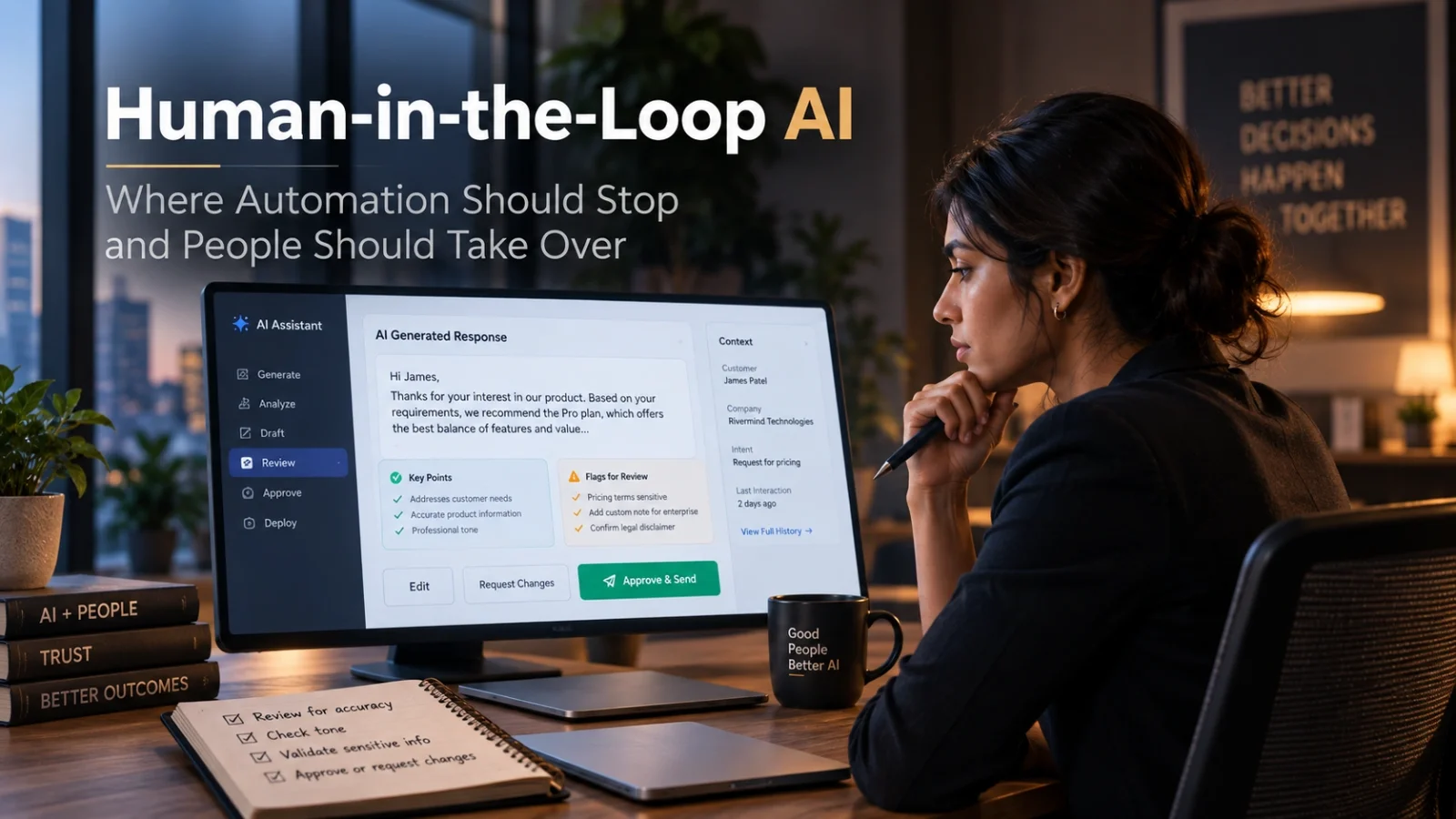
A practical framework for deciding which AI decisions can run automatically and which should require human review. The important part is not adding another tactic to the stack; it is building a system that is clear enough to implement, measure and improve.
Practical principle: Automate low-risk, repetitive decisions where the acceptable outcome is clearly defined and easy to verify.
What matters most
Automate low-risk, repetitive decisions where the acceptable outcome is clearly defined and easy to verify.
Require review when the decision affects refunds, contracts, high-value customers, compliance or other consequential outcomes.
Use confidence thresholds so uncertain AI outputs are routed to a person rather than forced into an automated answer.
Design the interface so reviewers can see the evidence, context and proposed action quickly.
Capture reviewer corrections and use them to improve prompts, rules and future automation quality.
A practical implementation approach
Begin with the current customer journey and the business outcome you want to improve. Document the present baseline, choose the smallest set of changes that can influence it, and assign clear ownership. For ai automation work, this prevents the project from turning into a collection of disconnected tasks.
Implementation should happen in a controlled sequence. Fix foundational issues first, then expand only after you can see whether the change improved performance. This makes it easier to separate genuine progress from normal week-to-week variation.
Common mistakes to avoid
How to measure whether it is working
Track approval rate, override rate, exception categories, review time and the business impact of prevented errors.
Choose a small number of metrics that connect directly to the business result. Reporting should make the next decision easier, not simply produce more charts.
Frequently asked questions
How should a business start with human-in-the-loop ai?
Start with one clearly defined business objective, document the current baseline, implement the smallest useful change and measure the result before expanding the scope.
How often should the approach be reviewed?
Review it whenever the website, customer journey, platform or business model changes materially, and use real performance data rather than relying on the original setup indefinitely.
Monk Media One approaches ai automation projects around measurable business outcomes, practical implementation and systems that teams can continue using after launch.
Turn the strategy into a measurable system.
Start with the highest-impact opportunity, implement it properly and measure what changes.
Explore AI Automation