Consider a website receiving 10,000 visitors every month.
At a 1% conversion rate, it generates 100 leads. Doubling traffic to 20,000 visitors could generate 200 leads—but usually requires considerably more SEO effort or advertising spend.
Improving the conversion rate from 1% to 2% produces the same 200 leads from the original traffic.
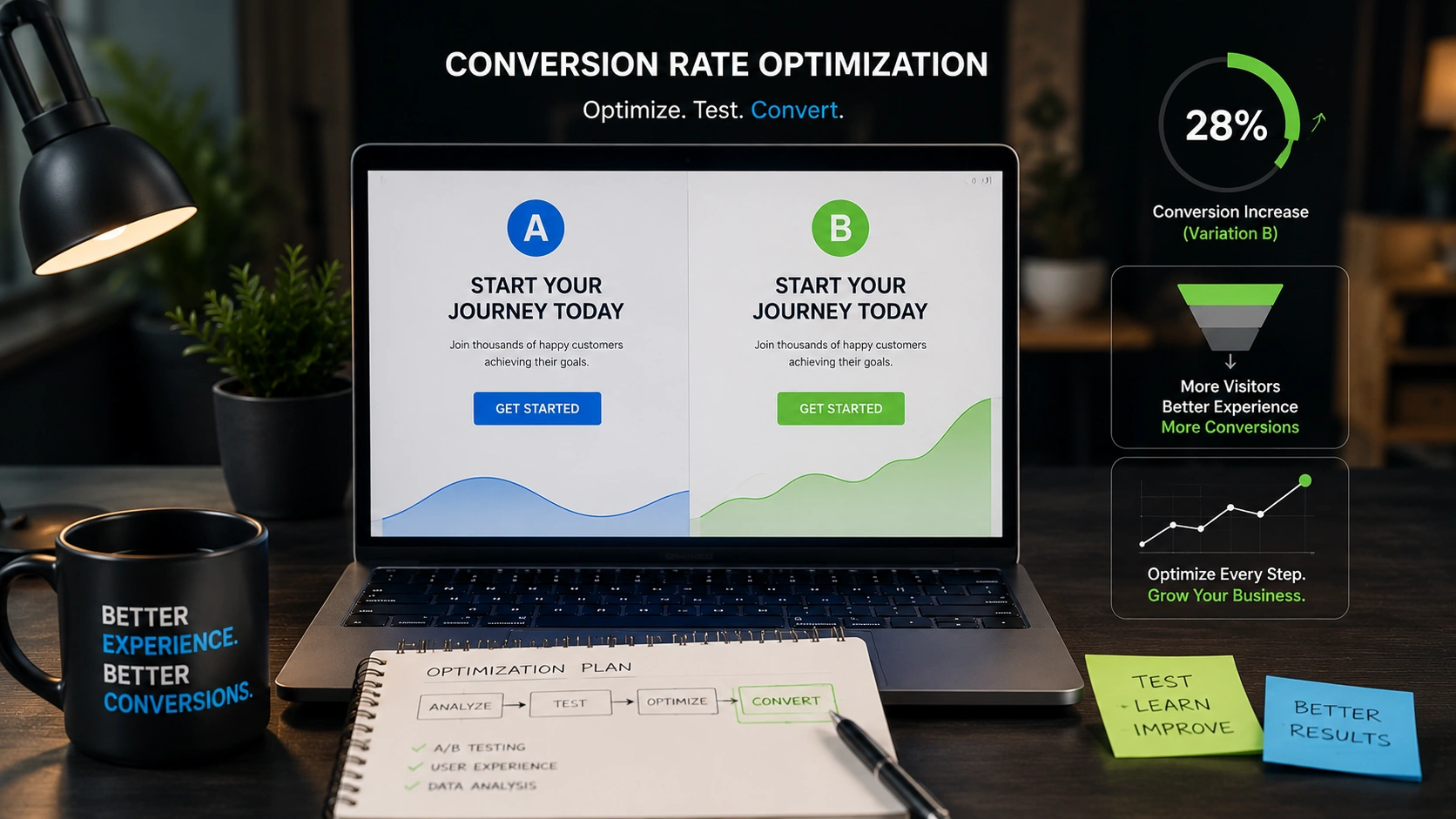
Conversion Rate Optimization is the process of getting more value from traffic you already have instead of relying only on acquiring more visitors.
What CRO actually involves
| Step |
What it reveals or improves |
| Analytics review |
Identifies the specific pages and steps where users leave the conversion journey |
| Heatmaps & session recordings |
Shows how real visitors interact with the page instead of relying on assumptions |
| A/B testing |
Compares headlines, layouts and calls to action using actual user behaviour |
| Form & checkout optimization |
Reduces friction at the point where the visitor is trying to convert |
The most common conversion friction points
Slow page speed
Visitors may leave before the page finishes loading, particularly on mobile devices.
Unclear value proposition
Users cannot quickly understand what the company offers or why it matters to them.
Long forms
Every unnecessary field introduces another opportunity for the visitor to abandon the process.
Missing trust signals
A lack of testimonials, reviews, pricing transparency or credibility indicators increases hesitation.
Weak calls to action
The visitor reaches the page but cannot immediately identify what they should do next.
The useful part is that many of these problems can be improved without rebuilding the entire website.
What kind of improvement is realistic?
Results depend heavily on the current conversion rate, industry and quality of incoming traffic.
A structured CRO programme may produce a 10–40% relative improvement over several months, although individual results vary significantly.
The strongest gains often come from obvious friction that has been ignored for a long time.
Where to start with a limited budget
Start with your highest-traffic page and your most important conversion step.
Review the existing analytics and fix clear problems first:
Page speed
Headline clarity
Navigation
Calls to action
Form length
Trust signals
More formal A/B testing becomes useful once the website receives enough traffic for the results to become statistically meaningful.
Fix obvious friction before investing in sophisticated testing infrastructure.
CRO and SEO solve different parts of the same problem
SEO is designed to bring qualified visitors to the website.
CRO improves the percentage of those visitors who take the desired action once they arrive.
They therefore work together rather than competing for the same role.
A business investing heavily in SEO or advertising while ignoring poor conversion is paying to send more people into a weak customer journey.
Frequently asked questions
Do I need a lot of traffic for CRO?
Formal A/B tests require meaningful traffic volume. Smaller websites can still gain significantly by reviewing analytics, usability and obvious friction points.
How is CRO different from SEO?
SEO increases qualified website traffic. CRO improves how effectively that traffic becomes leads, customers or other desired outcomes.
How quickly can CRO produce results?
Simple usability and clarity improvements can affect performance within weeks. Structured testing programmes normally operate continuously over several monthly cycles.
Monk Media One reviews conversion performance as part of website development and paid-marketing projects because strong traffic cannot compensate for a weak conversion experience.
Where the conversions are actually lost
CRO gets discussed as button colours and headline tests, which is why it is often dismissed. In practice
the large wins are structural, and they sit in four places:
The match between the ad and the page
The most common and most expensive leak. Someone clicks an ad for a specific product and lands on a
homepage, where they have to find it again. The fix is not a test, it is a landing page per campaign
that answers exactly what the ad promised, above the fold.
Friction in the form
Every field costs completions. Ask for what you need to make the next contact and nothing else. Phone
number and a name is often enough; company size, budget range and "how did you hear about us" can be
asked by a human later.
Missing answers
People do not convert when a question is unanswered: what does it cost, how long does it take, what
happens after I submit, is this available where I am. Sales teams know exactly which questions these
are, because they answer them on every call. Putting those answers on the page removes the reason to
leave and think about it.
Speed and layout stability
A page that takes five seconds, or where the layout jumps while loading and the visitor taps the wrong
thing, loses people before any messaging matters.
Why most A/B tests tell you nothing
Split testing is a statistical tool and it has requirements most sites cannot meet. To detect a genuine
improvement of a few percent you need a large number of conversions per variant, not a large number of
visitors. A site with twenty enquiries a month cannot run a meaningful test — it will produce a result,
and the result will be noise.
For lower-traffic sites, the alternatives are better anyway:
- Session recordings and heatmaps. Watching ten people fail to find the pricing tells you
more than a test with insufficient power.
- Asking customers. A short question to recent enquirers about what nearly stopped them
is cheap and unreasonably effective.
- Fixing the obvious. Most sites have several clear problems. Fix those before testing
subtleties.
- Sequential before-and-after. Imperfect, but honest if you account for seasonality and
change one substantial thing at a time.
Measure the right conversion
Optimising the wrong metric is worse than not optimising. Removing form fields will raise form
completions and can lower qualified enquiries; a more aggressive popup will raise sign-ups and can
lower the quality of the list.
Define the conversion as far down the funnel as your systems can see — a qualified enquiry, a booked
call, a closed sale — and judge changes against that. If you cannot see past the form submission, at
minimum ask the sales team whether lead quality moved after a change.
A practical order of work
- 1. Instrument properly. Conversion events, source tracking, and a way to tie an enquiry
to what it became. Without this, everything after is guessing.
- 2. Fix technical performance. Speed and layout stability, because they affect every
page.
- 3. Align pages with traffic sources. Dedicated landing pages for campaigns.
- 4. Answer the sales objections on the page. Cost, timeline, process, guarantees.
- 5. Reduce form friction. Fewer fields, clearer next step.
- 6. Then test. Once volume supports it and the obvious is done.
Frequently asked questions
What is a good conversion rate?
There is no useful benchmark, because the number depends on traffic source, intent, price point and how the conversion is defined. Branded search converts many times better than cold social traffic on the same site. The only comparison that means anything is your own rate over time, segmented by source.
How much traffic do we need before A/B testing is worth it?
Enough conversions per variant, not visitors — which is why most small-business sites cannot test meaningfully. If you get a few dozen enquiries a month, session recordings, customer questions and fixing obvious problems will produce far more improvement than a test that runs for three months and returns noise.
Is CRO cheaper than buying more traffic?
Usually, because it compounds across every channel at once. Improving the rate at which visitors become enquiries makes existing SEO and paid spend more efficient simultaneously, and unlike media spend it does not stop when you stop paying. It is not unlimited, though — there is a ceiling, and past it more traffic is the answer.
What is the single most common conversion problem?
Sending campaign traffic to a homepage. The visitor clicked something specific and arrived somewhere general, and now has to search for what they were promised. A dedicated landing page per campaign is usually the largest single improvement available on any site running paid media.
Should we add a chat widget?
It can help if someone answers quickly; it hurts if it is a bot that cannot answer the question that was actually asked, because it consumes the visitor's patience and then fails. The test is whether it resolves the common questions faster than reading the page would. If not, put those answers on the page instead.