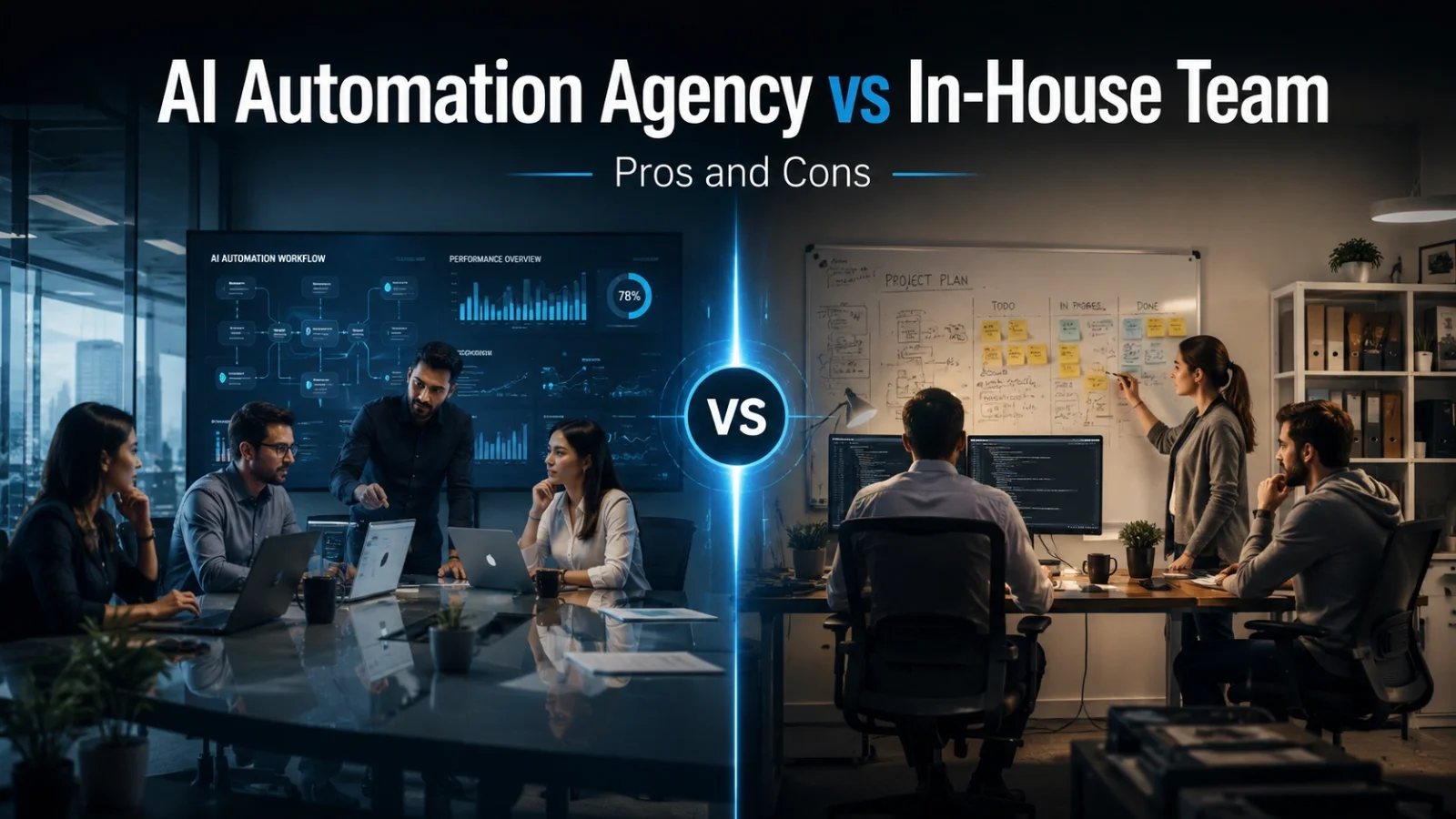
Hiring an in-house automation specialist may cost several lakhs per year before tools, infrastructure and management time are considered.
An agency can often build several workflows for less, but cost alone should not decide the model.
The real question is whether automation is supporting the business—or becoming a core part of the product itself.
Agency vs in-house automation
| Factor |
Agency |
In-house |
| Initial cost |
Usually lower for a limited number of projects |
Higher because of salary, hiring and infrastructure |
| Speed |
Often faster for common workflows because patterns already exist |
Depends heavily on the individual hire and onboarding |
| Specialisation |
Access to multiple tools and disciplines |
Deep knowledge of the company and internal systems |
| Flexibility |
Easy to scale project scope up or down |
Fixed internal capacity |
| Ownership |
Requires clear documentation and account ownership |
Knowledge stays closer to the business |
| Best fit |
Validation, operational workflows and limited automation demand |
Continuous product development and strategically critical systems |
When an agency makes more sense
An agency is often the better starting point when the business needs a small number of defined workflows.
Common examples include AI chatbots, WhatsApp automation, CRM workflows, lead scoring, customer-support systems and automated reporting.
The agency can often reuse proven architecture instead of learning every platform from the beginning.
When an in-house team becomes stronger
Internal ownership becomes more valuable when automation is deeply connected to the company's product or daily technical roadmap.
An in-house specialist makes more sense when systems require frequent development, deep codebase knowledge or continuous interaction with product and engineering teams.
The more strategically central the automation becomes, the stronger the case for internal ownership.
The common expensive mistake
Businesses sometimes hire an automation engineer before they know which workflows actually create value.
The result can be a costly internal resource spending months experimenting with tools rather than solving validated business problems.
A safer sequence is often:
1. Build the first workflows externally
2. Measure the operational or financial impact
3. Document the systems
4. Hire internally when ongoing demand justifies it
A hybrid model can work well
The decision does not have to remain permanently agency versus in-house.
A business can begin with an agency, validate its automation opportunities and later build an internal team while keeping the agency for specialist work or overflow capacity.
The important requirement is ownership.
Your business should retain access to accounts, data, documentation, workflows, integrations and source code where applicable.
Frequently asked questions
When should a company hire internally?
Internal hiring becomes more practical when there is a continuous automation roadmap and the systems are strategically important to the product or operations.
Is an agency always cheaper?
No. For continuous high-volume development, an internal team may eventually become more economical than ongoing project fees.
Who should own the automation accounts?
The client should retain ownership of critical accounts, data and access credentials wherever possible.
Monk Media One builds AI automation systems with documentation and client ownership so businesses can continue with an external partner or transition systems in-house as they grow.
Choose the automation model that fits your stage.
Validate the workflows first, then decide how much capability genuinely needs to move in-house.
Explore AI Automation
The decision is rarely all-or-nothing
Framed as a choice between hiring and outsourcing, this question usually gets answered badly, because
the two options have different shapes. An agency brings breadth immediately and leaves. An in-house
hire brings continuity and context but takes months to become effective and covers one skill set.
Most businesses that get this right use a sequence rather than a choice: bring in outside help to find
and build the first automations, then hire internally to own and extend them once the value is proven
and the shape of the work is known. Hiring first means writing a job description for work you have not
yet defined.
The real costs on each side
In-house
- Salary is the visible cost and typically the smaller half. Add recruitment, onboarding, tooling
licences, training and the management time the role consumes.
- Time to productivity: three to six months before someone new is genuinely delivering, longer if nobody
internally can direct the work.
- Single-person risk. If your automation knowledge lives in one head and that person leaves, so does the
ability to maintain what they built.
- Breadth limits. Automation touches process design, integrations, data and sometimes front-end work. One
hire rarely covers all of it.
Agency
- Higher day rate, no employment overhead, and it stops when you stop.
- Immediate breadth — process, integration and build skills without three hires.
- Knowledge transfer risk: if documentation and handover are not in the scope, the understanding leaves
with them. This is the failure mode to guard against.
- Less context. An outsider will not know why a process has an unusual step until someone explains it,
and the explanation is often the most valuable hour of the project.
A test that resolves it quickly
Answer four questions honestly:
- Do you know which processes to automate? If not, you need diagnosis, not a hire.
- Is this continuous or a project? A handful of workflows is a project. An ongoing
programme of internal tooling is a role.
- Can you direct the work? A junior in-house hire with nobody to learn from will
struggle regardless of ability.
- How exposed are you if this person leaves? The more critical the automation, the more
you need documentation and more than one person who understands it — which is a discipline, not a
staffing model.
Three or more answers pointing at "we are not sure yet" means starting with outside help and hiring
later will cost less than hiring now.
How to measure whether it worked
Both routes are frequently judged on impression rather than evidence, which is how businesses end up
with a dozen automations and no idea whether any of them saved anything. Before building, record two
numbers for the process you are about to change: how long it takes per week, and how often it goes
wrong. Both are usually estimates, and that is fine — an estimate you wrote down beforehand is far more
useful than a confident recollection afterwards.
A month after the automation is live, take the same two measurements. The comparison answers the only
question that matters: whether the time recovered justifies the cost of building and maintaining it.
It also tells you whether to fund the next phase, which is a much easier conversation to have with a
real number than with a demonstration.
Making either choice work
Whichever route you take, the same three things determine whether the automation survives contact with
reality:
- Documentation as a deliverable. Not a nice-to-have. What was built, why, what it
connects to, and how to change it.
- Failure alerting. Automations fail silently. A workflow that has been broken for two
weeks before anyone notices is worse than no automation, because people stopped checking manually.
- A named owner. Someone internal who is responsible for the automation working, even if
they did not build it.
Frequently asked questions
When does hiring in-house become the cheaper option?
When the work is continuous rather than a set of projects, and when someone internal can direct it. If you have a rolling programme of internal tooling and a manager who understands the processes well enough to prioritise, an in-house hire wins on cost within the first year. If the work is a handful of workflows, the fixed costs of hiring never amortise.
What is the biggest risk with an agency?
Knowledge leaving with them. Automations are only maintainable if someone can understand what was built and why. Make documentation and a handover walkthrough contractual deliverables rather than assuming they come as standard, and insist that credentials sit in your accounts rather than theirs.
Can we start with one automation and see how it goes?
That is usually the best approach. Pick a process that visibly costs someone hours every week, automate that one properly, and measure what was actually saved after a month. It is a small commitment, it produces a real number to make the next decision with, and it tells you whether the constraint was really the process or something else.
Do we need someone technical internally either way?
You need someone who owns the outcome, which is not the same as someone who can build. That person needs to know what each automation does, notice when one stops working, and decide what happens next. Without that role the work degrades quietly regardless of who built it.
How do we stop automation from being resisted by the team?
Be specific and honest at the start about what changes. The work that automates well is generally the work nobody wanted — data entry, chasing, copying between systems — and saying so plainly is more persuasive than reassurance. Involving the people who do the process in mapping it also produces a better automation, because they know the exceptions the manual does not mention.